February 20, 2026
How Many Kanji Are Required for Each JLPT Level?
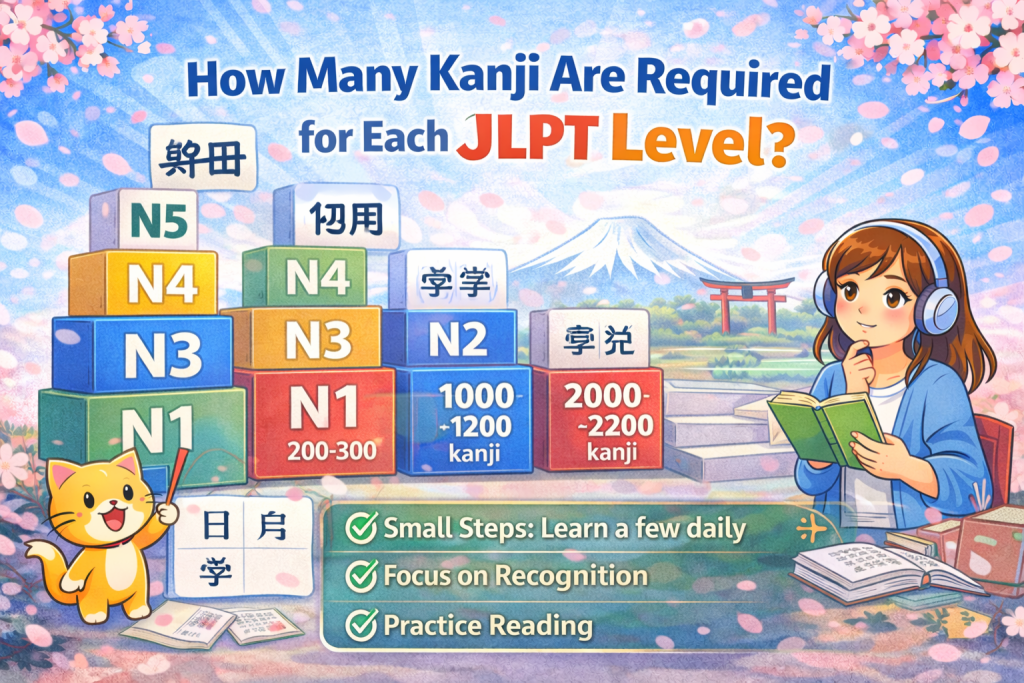
Kanji is one of the most important and often most challenging parts of learning Japanese. If you’re preparing for the JLPT, you’ve probably wondered, How many kanji do I actually need to know?
The JLPT, officially known as the Japanese-Language Proficiency Test, is divided into five levels: N5 (beginner) to N1 (advanced). Each level requires you to recognize more kanji and understand them in real reading situations.
Let’s explore how kanji requirements grow at each level and what you can expect.
Why Kanji Is Important for JLPT
Kanji appears everywhere in Japanese books, signs, menus, websites, and exams. In the JLPT, kanji is especially important for:
Reading passages
Understanding vocabulary
Answering grammar questions
Comprehending written instructions
The higher the level, the more kanji you’ll need to recognize quickly.
The good news is: JLPT tests recognition, not writing. You don’t need to write kanji by hand—only understand and read them.
JLPT Kanji Requirements by Level
Here’s a general estimate of how many kanji are required at each level:
JLPT Level Approximate Kanji Difficulty
N5 80–120 Beginner
N4 200–300 Elementary
N3 600–700 Intermediate
N2 1000–1200 Advanced
N1 2000–2200 Very Advanced
These numbers are approximate, but they give a realistic idea of the progression.
N5: Your First Kanji
At N5, you’ll learn basic kanji used in everyday life.
Examples include:
日 (day, sun)
月 (month, moon)
人 (person)
山 (mountain)
学 (study)
These kanji appear in simple words and beginner sentences.
At this stage, the focus is on building familiarity and confidence.
N4: Expanding Your Knowledge
At N4, you’ll begin recognizing more kanji used in common situations.
Examples include:
店 (shop)
時 (time)
電 (electric)
車 (car)
新 (new)
You’ll start reading short paragraphs and understanding more detailed information.
N3: Entering Intermediate Level
N3 marks a major transition. Kanji becomes more important for understanding longer texts.
Examples include:
開 (open)
意 (meaning)
関 (relationship)
説 (explain)
経 (experience)
You’ll encounter kanji in articles, stories, and real-life materials.
N2: Advanced Reading Ability
At N2, kanji knowledge becomes essential for understanding professional and formal content.
Examples include:
識 (knowledge)
議 (discussion)
資 (resource)
率 (rate)
済 (finish, complete)
You’ll be able to read newspapers, formal documents, and detailed texts.
N1: High-Level Mastery
N1 requires extensive kanji knowledge and strong reading ability.
Examples include:
論 (argument)
警 (warning)
観 (observe)
題 (topic)
識 (consciousness)
You’ll encounter these kanji in academic writing, editorials, and advanced materials.
How to Learn Kanji Effectively
Learning kanji can feel overwhelming, but the right approach makes it manageable.
Here are some proven tips:
- Learn kanji together with vocabulary
- Study a small number daily
- Review regularly
- Practice reading frequently
- Focus on recognition first
- Consistency is more important than speed.
- Even learning 5 kanji per day adds up quickly over time.
Kanji is a long-term part of your Japanese learning journey. Each JLPT level introduces new characters, but the progression is designed to be gradual. You don’t need to learn everything at once. Start with beginner kanji, build your knowledge step by step, and practice reading regularly. Over time, kanji will stop feeling intimidating and start feeling familiar.