February 6, 2026
Should You Take JLPT While Self-Studying?
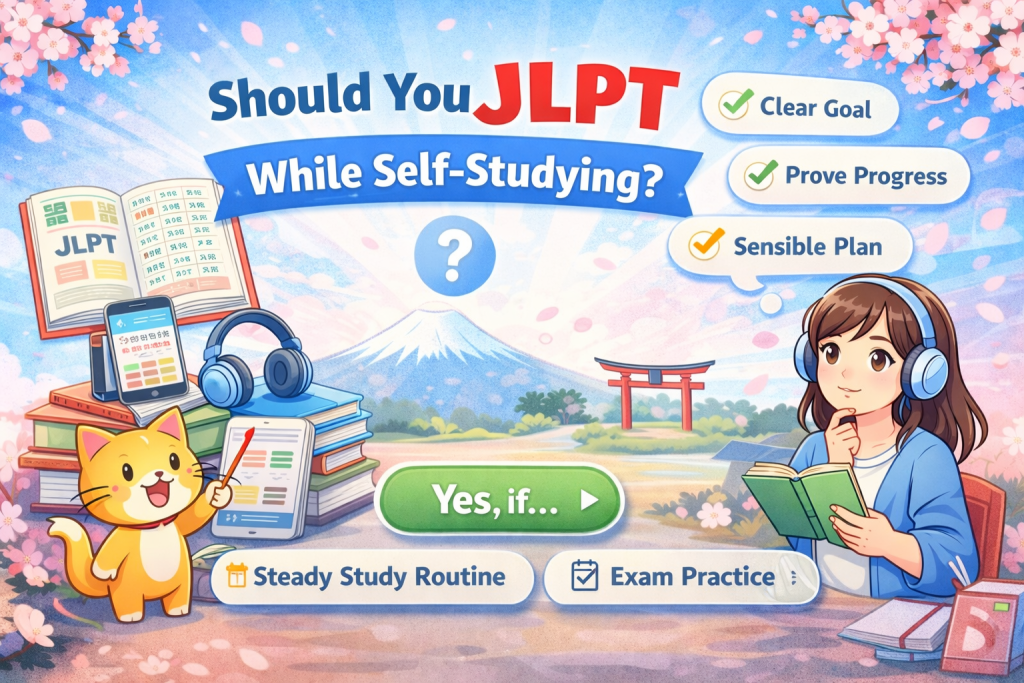
If you’re learning Japanese on your own through books, apps, YouTube videos, or online courses you may be asking yourself:
Is it worth taking the JLPT without joining a class?
The JLPT short for the Japanese-Language Proficiency Test is the most widely accepted exam for measuring Japanese language ability among non-native speakers.
Many learners successfully pass the test through self-study alone. But whether you should attempt it right now depends on your goals, level, and daily habits.
Let’s break it down in simple terms.
Can You Pass JLPT by Self-Study?
Yes—absolutely.
Thousands of learners prepare on their own every year and pass, especially at beginner and intermediate levels. You don’t need a classroom if you have:
- a steady study routine
- good learning materials
- regular revision
- practice tests
- patience and consistency
- Self-study works best when you treat it seriously and follow a clear plan.
Why Self-Study Learners Take JLPT
Here are some good reasons to sit for the exam even if you’re learning alone.
1) It Gives You a Clear Target
Instead of studying Japanese without direction, JLPT gives you a specific level and deadline to work toward.
2) It Shows Your Progress
Passing an official test proves how far you’ve come—especially useful for job applications, study programs, or personal motivation.
3) It Helps You Organize Your Learning
JLPT levels list the grammar, vocabulary, and kanji you need to know. This makes it easier to plan your weekly study goals.
4) It Builds Confidence
Passing after months of self-study feels amazing. It’s proof that your method is working 💪
Challenges of Preparing Alone
Self-study is powerful, but it comes with a few difficulties.
❌ No Teacher Feedback
You may not always notice mistakes in grammar or pronunciation.
❌ Motivation Can Drop
Without classes, it’s easy to skip days.
❌ Less Speaking Practice
JLPT doesn’t test speaking, but speaking still helps your overall understanding.
❌ Hard to Judge Your Level
Some learners choose a level that is too high and get discouraged.
The good news? All of these problems can be managed with smart planning.
How to Know If You’re Ready
Ask yourself honestly:
- Do I study at least 20–30 minutes most days?
- Have I learned most of the grammar for my target level?
- Have I tried sample JLPT questions?
- Do I understand why answers are right or wrong?
- Am I practicing listening regularly?
If you answered “yes” to most of these, you’re probably ready to attempt the exam.
Which Level Is Best for Self-Study Learners?
For most people:
- New learner → N5
- Studied a few months → N4
- Comfortable with basics → N3
Starting too high is a common mistake. Passing a lower level first is often the smarter move.
How to Prepare for JLPT on Your Own
If you decide to go for it, here are some simple tips.
- Follow the Syllabus: Know what grammar, vocabulary, and kanji your level requires.
- Take Practice Tests Early: Don’t wait until the final month test yourself often.
- Mix Skills Every Week:
- grammar
- vocabulary
- listening
- reading
- Track Weak Areas: Keep a notebook or file for mistakes you repeat.
- Add Speaking Practice: Talk to language partners or read sentences aloud to build confidence.
You may want to delay taking JLPT if:
- you just started learning Japanese
- you haven’t mastered hiragana yet
- you can’t study regularly
- you haven’t tried any mock tests
In that case, spend a little more time building the basics first.
Yes, you can take the JLPT while self-studying.
If you study consistently, follow a level-based plan, and practice with real exam questions, the test can become a motivating milestone in your Japanese journey.