March 11, 2026
Confusing Japanese Grammar Points Finally Explained
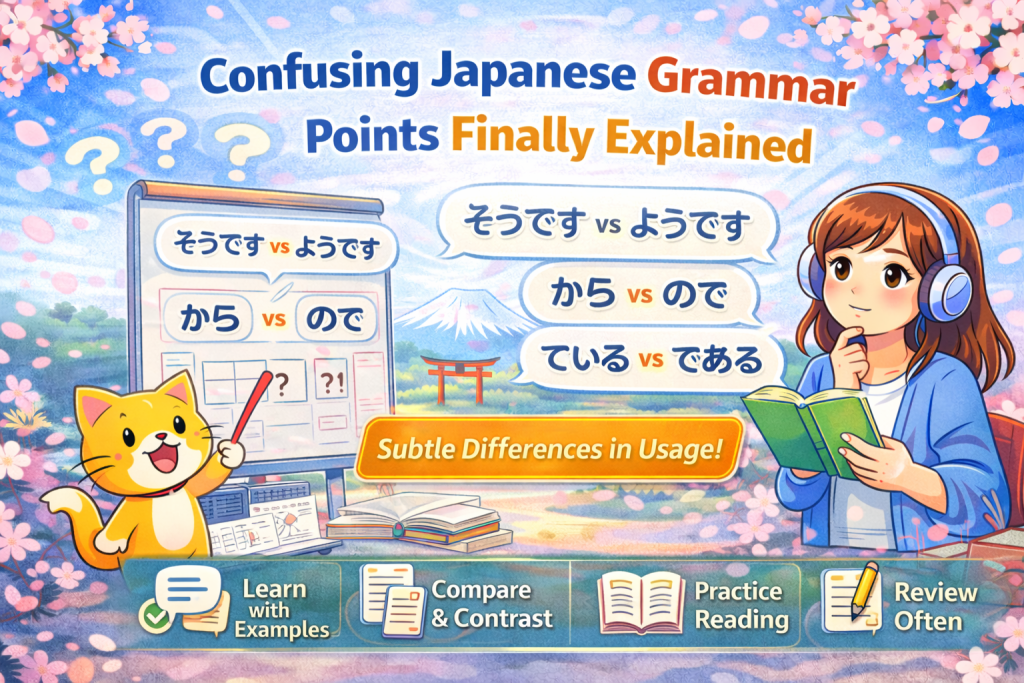
If you’ve been learning Japanese for some time, you’ve probably encountered grammar points that look almost identical but have slightly different meanings. At first, this can feel frustrating. You study one pattern, understand it well, and then suddenly find another structure that seems almost the same.
The truth is that Japanese grammar often expresses subtle differences in meaning, intention, or politeness. Once you understand these differences, the grammar becomes much clearer.
Many of these patterns also appear frequently in the Japanese-Language Proficiency Test, which is why understanding them properly is important for both communication and exam preparation.
In this article, we’ll explore some of the most confusing Japanese grammar pairs and explain them in simple terms.
1. そうです vs ようです
Both expressions can be translated as “it seems” or “it looks like.” However, the way they are used is slightly different.
そうです is used when something appears to be happening based on what you see.
Example:
雨が降りそうです。
“It looks like it will rain.”
Here, the speaker is judging based on visible signs, such as dark clouds.
On the other hand, ようです is used when you make a conclusion based on information, evidence, or general observation.
Example:
彼は忙しいようです。
“He seems busy.”
In this case, the speaker is not just looking at the situation but interpreting it based on available clues.
2. から vs ので
Both から and ので mean “because,” but they differ in tone.
から is more direct and commonly used in casual conversations.
Example:
雨だから行きません。
“I’m not going because it’s raining.”
ので sounds softer and more polite, making it suitable for formal or respectful situations.
Example:
雨なので行きません。
“I’m not going because it’s raining.”
While the meaning is similar, the level of politeness changes the feeling of the sentence.
3. ~ている vs ~てある
These two grammar patterns are often confused because they both describe a state that results from an action.
~ている usually describes an ongoing action or a current condition.
Example:
ドアが開いています。
“The door is open.”
This sentence simply describes the current state of the door.
~てある, however, describes a state that exists because someone intentionally did something.
Example:
ドアが開けてあります。
“The door has been left open.”
This implies that someone intentionally opened the door for a reason.
4. まだ vs もう
These two words are related to time and completion of actions.
まだ means “still” or “not yet.”
Example:
まだ食べていません。
“I haven’t eaten yet.”
It shows that something has not happened but may happen later.
もう means “already.”
Example:
もう食べました。
“I already ate.”
It indicates that an action has been completed.
Understanding the context of the sentence helps determine which word to use.
5. ために vs ように
Both of these expressions can mean “for the purpose of” or “so that,” but they are used in different situations.
ために is used when the action is intentional and under the speaker’s control.
Example:
日本語を勉強するために日本へ行きました。
“I went to Japan to study Japanese.”
ように, however, is used when the result is not fully controllable.
Example:
忘れないようにメモを書きました。
“I wrote a note so that I wouldn’t forget.”
The difference lies in whether the outcome is something you can directly control.
Why Japanese Grammar Can Feel Confusing
Japanese grammar can be challenging because many expressions have similar meanings but different nuances. These small differences may relate to:
politeness level
intention versus observation
certainty versus possibility
casual versus formal situations
Understanding these nuances takes time and practice.
How to Master Difficult Grammar Points
If certain grammar patterns keep confusing you, try these study strategies:
Compare similar grammar patterns side by side
Learn through example sentences rather than definitions
Practice reading Japanese regularly
Write your own sentences using new grammar
Review patterns frequently
Over time, you will begin to recognize these structures naturally.
Japanese grammar may seem complicated at first, but most confusion comes from small differences in meaning rather than completely different rules. Once you start noticing the context and intention behind each grammar pattern, the language becomes much easier to understand.
Instead of memorizing grammar mechanically, focus on how it is used in real sentences. With practice, the patterns that once seemed confusing will gradually become clear.
Learning Japanese is a journey of steady progress, and every grammar point you master brings you one step closer to fluency.