February 12, 2026
JLPT Levels Explained: N5 to N1
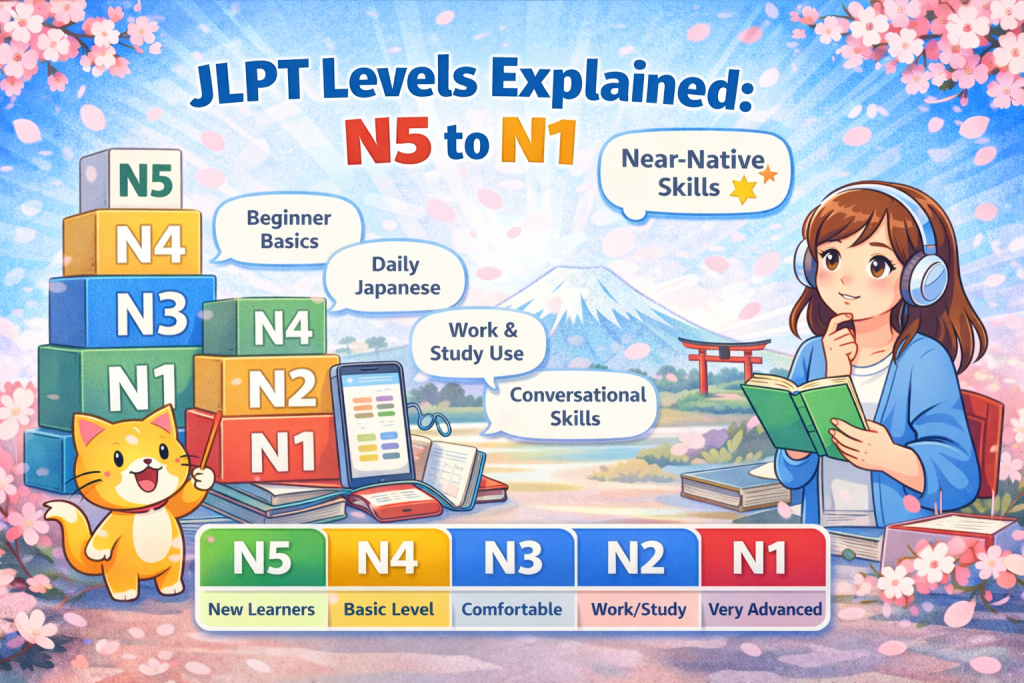
If you are learning Japanese, you have probably heard people talk about “N5,” “N3,” or even “N1.” But what do these levels actually mean? And how different are they from each other?
The JLPT officially known as the Japanese-Language Proficiency Test is divided into five levels. These levels measure your ability in vocabulary, grammar, reading, and listening.
Let’s walk through each level clearly and simply, so you can understand where you are and where you’re headed.
N5 – The Starting Point
Level type: Beginner
N5 is designed for learners who are just beginning their Japanese journey.
At this level, you can:
Read hiragana and katakana
Understand very basic grammar
Form simple sentences
Recognize around 100 basic kanji
Follow slow and simple conversations
You can talk about everyday topics like your name, family, hobbies, and daily routine.
For most new learners, N5 is the ideal first goal. It builds confidence and creates a strong foundation.
N4 – Building Confidence
Level type: Elementary
N4 expands on the basics and introduces more vocabulary and grammar patterns.
At this level, you can:
Read short passages
Understand everyday conversations
Use casual and polite forms
Recognize around 300 kanji
Follow simple conversations at natural speed
You’re no longer just understanding isolated sentences—you’re beginning to understand connected ideas.
N4 strengthens your foundation and prepares you for more complex Japanese.
N3 – The Bridge Level
Level type: Intermediate
N3 is often considered the turning point between beginner and advanced Japanese.
At this level, you can:
Understand everyday conversations more smoothly
Read short articles and simple news
Follow conversations at near-natural speed
Recognize around 600–700 kanji
Handle more complex grammar
Many learners aim for N3 because it shows practical ability in daily communication.
It’s a big step up from N4 and requires stronger reading and listening skills.
N2 – Professional Level
Level type: Advanced
N2 is often required for working or studying in Japan.
At this level, you can:
Read newspapers and longer articles
Understand formal and professional language
Follow fast-paced conversations
Recognize 1000+ kanji
Understand nuanced grammar
Passing N2 shows that you can function in real-life Japanese environments like offices or universities.
For many learners, N2 is the ultimate practical goal.
N1 – High Proficiency
Level type: Very advanced
N1 is the highest JLPT level.
At this level, you can:
Understand abstract and academic texts
Follow fast, natural speech
Read novels, essays, and editorials
Recognize 2000+ kanji
Understand subtle grammar differences
N1 does not mean “native level,” but it shows very high fluency and deep understanding of Japanese.
It’s often pursued by those who want specialized careers or academic paths.
How the Levels Progress
Each level increases in:
Vocabulary size
Kanji knowledge
Reading difficulty
Listening speed
Grammar complexity
Progress happens step by step. Which Level Should You Aim For?
- Just starting? → N5
- Studying for several months? → N4
- Comfortable with daily Japanese? → N3
- Planning to work in Japan? → N2
- Seeking high-level mastery? → N1
The key is choosing a level that challenges you without overwhelming you. The JLPT levels are milestones in your Japanese journey. There’s no need to rush to N1.
Start where you are.
Build strong basics.
Move forward gradually.
Every level you pass represents real growth and real effort.