February 6, 2026
Which JLPT Level Should You Take First?
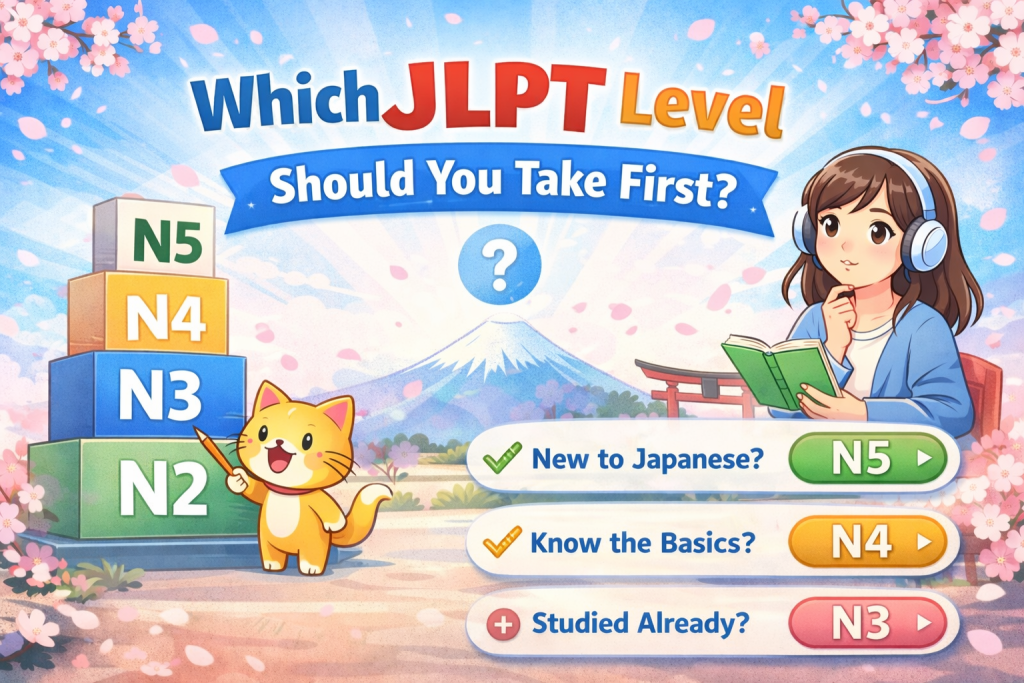
If you’re new to Japanese and thinking about taking the JLPT, one of the first questions you’ll ask is:
Which level should I start with?
The JLPT short for the Japanese-Language Proficiency Test has five levels, from beginner to very advanced. Choosing the right one matters a lot: start too high and it can feel discouraging; start too low and you might not challenge yourself enough.
Let’s make it simple.
Quick Overview of JLPT Levels
Here’s how the levels are generally understood:
N5 – Beginner
N4 – Elementary
N3 – Intermediate
N2 – Advanced
N1 – Near-native level
Most learners do not jump into the middle or top levels right away. The best starting point depends on your current Japanese ability.
If You’re a Complete Beginner → Start With N5
Choose N5 if:
you just started learning Japanese
you are learning hiragana and katakana
you know only a few kanji
you can say very simple sentences
you’ve never studied grammar seriously
N5 focuses on:
basic sentence patterns
polite forms (~です / ~ます)
common verbs and adjectives
everyday listening
around 100 beginner kanji
For most people, N5 is the safest and smartest first choice.
If You’ve Studied a Little → Consider N4
N4 may be right if you:
finished a beginner textbook
understand simple conversations
can read short passages
know basic grammar and particles
recognize a few hundred kanji
This level adds:
longer sentences
more vocabulary
casual forms
slightly faster listening
If N5 feels too easy in practice tests, N4 could be a better fit.
If You’re Comfortable With Basics → Look at N3
N3 is a big step up and is often seen as the “bridge” to advanced Japanese.
Consider N3 only if you:
understand everyday Japanese
can read simple articles
know many grammar patterns
follow normal-speed speech sometimes
already passed N4 or studied at that level
This is usually not a first test for beginners.
Should You Ever Start at N2 or N1?
In most cases—no.
N2 and N1 are meant for learners who:
have studied Japanese for years
read newspapers or novels
understand formal language
plan to work or study in Japanese
If you haven’t taken JLPT before, these levels are almost never the starting point.
How to Decide in 3 Simple Steps
Not sure where you stand? Try this:
1) Take a Sample Test
Look for official-style JLPT practice questions and see which level feels manageable.
2) Check the Syllabus
Review what grammar, vocabulary, and kanji each level expects.
3) Be Honest About Comfort
Ask yourself:
Can I understand most of this without guessing?
Can I finish in time?
Do I know why an answer is right?
If you’re guessing a lot, drop one level.
Common Beginner Mistake: Starting Too High. Many learners choose a higher level because it sounds impressive. That often leads to:
- frustration
- slow progress
- loss of motivation
Passing a lower level builds confidence and gives you a clear milestone. You can always move up next time.
Starting at the right level makes your JLPT journey smoother, more fun, and much more successful.